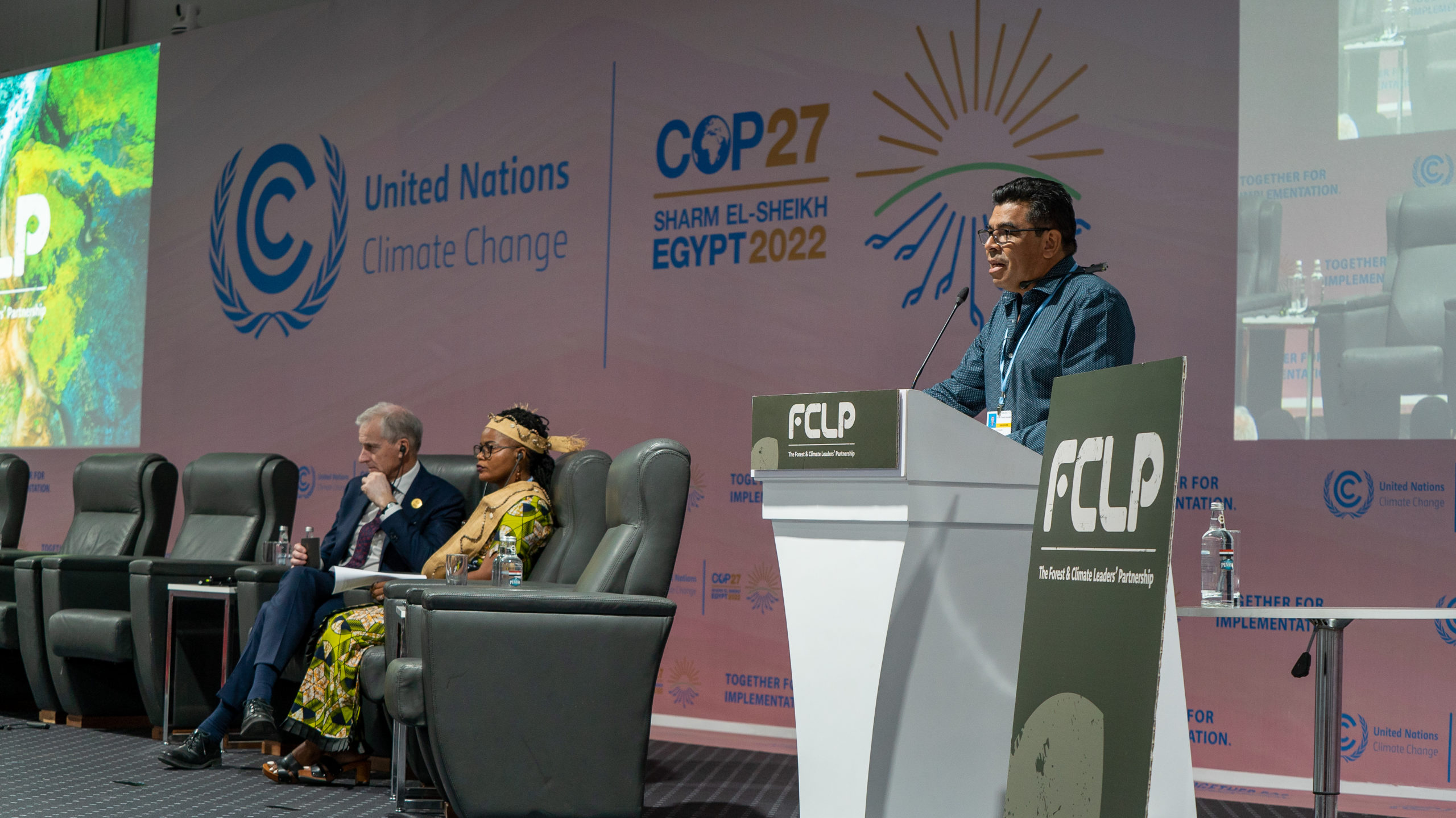
An urgent call to action was made by the Global Alliance of Territorial Communities (AGCT) to the world's leaders during the Leaders' Summit on Forests and Climate at COP27, being held in Sharm El Sheikh, Egypt.
“Lo más importante que teníamos era el tiempo, y ya lo perdimos. Por eso, hoy vengo a decirles ¡basta ya! de acuerdos, declaraciones y compromisos, que se quedan en la nube de los eventos globales como la COP y no aterrizan en los territorios, donde realmente se hace el cambio”, afirmó Levi Sucre, Coordinador de la Alianza Mesoamericana de Pueblos y Bosques (AMPB) y Co-presidente de la AGCT.
The Leaders' Summit on Forests and Climate takes place within the framework of the World Leaders' Summit and brings together ambitious governments, companies, financial actors and non-state leaders to increase ambition on forests and land use. The event addresses four themes: delivering on the Glasgow commitments; restoration in Africa; transforming the financial system; and accelerating forest finance.
"Today we come to tell you that while at the COPs they met to warn us that the climate was going to change, the climate has already changed. And those of us who see the impacts of climate change are us. Those of us who suffer the impacts have also proposed solutions and those solutions have been backed by science." - Levi Sucre
The AGCT demands concrete actions to protect the rights of indigenous peoples and local communities as the only way to urgently protect ecosystems as needed to combat climate change, biodiversity loss and the emergence of future pandemics.
To do so, the Alliance proposes to open avenues for dialogue and collaboration with governments, multilateral organizations and donors.
"Today I want to call on you to work with us: the communities that contribute the most to the fight against climate change, the ones that receive the most of its direct impacts and the ones that receive the least climate finance.Without us, there is no future."- Levi Sucre
Call of science
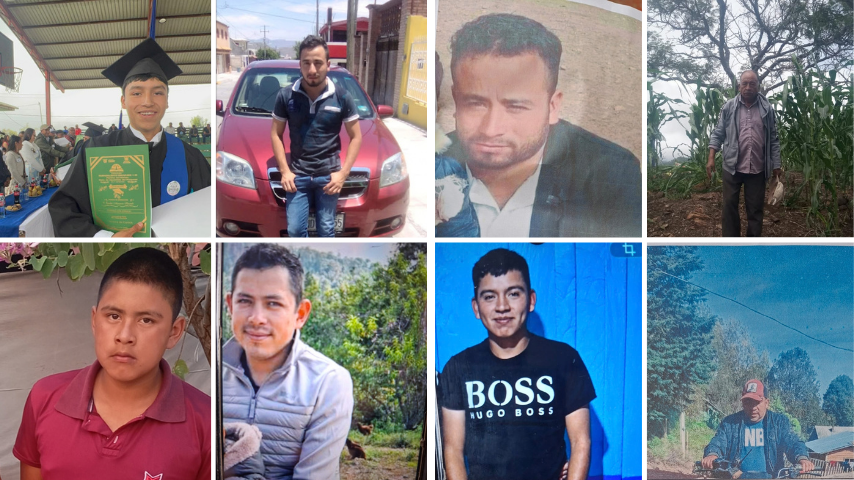
Despite the growing recognition of the role of indigenous and local the role of indigenous and local communities as stewards of nature is increasingly recognized, relevant national legislation is weak or non-existent, exposing them to ever-increasing dangers. As governments negotiate at the Sharm el Sheikh COP, an estimated 14 indigenous defenders will be killed for protecting Mother Earth.
As if that were not enough, some of the solutions that countries are putting on the table also threaten to harm the biodiversity-rich forests that these communities protect around the world. A new study by the University of Melbourne's Melbourne Climate Futures estimates that countries need, between them, a total of 1.2 billion hectares of land to deliver on the promises made in their official climate plans. Such dangerous reliance on land-based methods to sequester carbon would gobble up much of our ancestral lands, the very lands we desperately need for food production and nature protection. It is simply not feasible to plant trees to escape climate catastrophe; there is not enough land. Instead, we need to protect and restore existing forests, and that can only be done with indigenous peoples and local communities.
An overwhelming body of evidence shows that ecosystems thrive and nature is in balance when indigenous peoples and local communities have secure tenure over their traditional lands. Scientists who warned the world in 2019 that one million species are at risk of extinction now say that sustainable use of wild species requires strengthening indigenous peoples' land rights and harnessing our wisdom.
Despite the enormous efforts of allies in the cause of indigenous peoples and local communities, little funding actually reaches our communities: less than 1% of all funds earmarked to protect the environment. Long-standing bureaucratic systems and beliefs about our capabilities prevent us from accessing the climate funds we are capable of managing for the benefit of all. We are the guardians of humanity's future and we need all the support that is available to keep tomorrow's hope alive.
In the words of the IPCCranked as "very high confidence" in a 2022 report and quoted in the new global study released today: "Support for indigenous self-determination, recognition of indigenous peoples' rights and support for adaptation based on indigenous knowledge are critical to reducing climate change risks and achieving effective adaptation (very high confidence)".
In all these fields of scientific research, the contributions of indigenous peoples and local communities, traditional knowledge and the recognition of territorial rights are mentioned. That is why AGCT calls on politicians, funders, decision-makers, journalists and advisors to listen to science. There is abundant evidence and studies showing that working with indigenous peoples and local communities is the only way to keep hope alive for humanity's tomorrow.
About the Global Alliance of Territorial Communities
The Global Alliance of Territorial Communities is a political platform of indigenous peoples and local communities united to defend Mother Earth for the present and future benefit of all humanity. It guarantees its legitimacy and representativeness through democratic processes, ranging from the community to the plurinational level.
The alliance represents 35 million people living in forest territories in 24 countries in Asia, Africa and Latin America, defenders of more than 958 million hectares of land.
Las cinco organizaciones que la conforman son la Alianza Indonesia de Pueblos Indígenas del Archipiélago (AMAN); la Alianza Mesoamericana de Pueblos y Bosques (AMPB); la Articulación de Pueblos Indígenas de Brasil (APIB); la Coordinadora de Organizaciones Indígenas de la Cuenca Amazónica (COICA); y la Red de Pueblos Indígenas y Locales para la Gestión Sostenible de los Ecosistemas Forestales de África Central (REPALEAC).