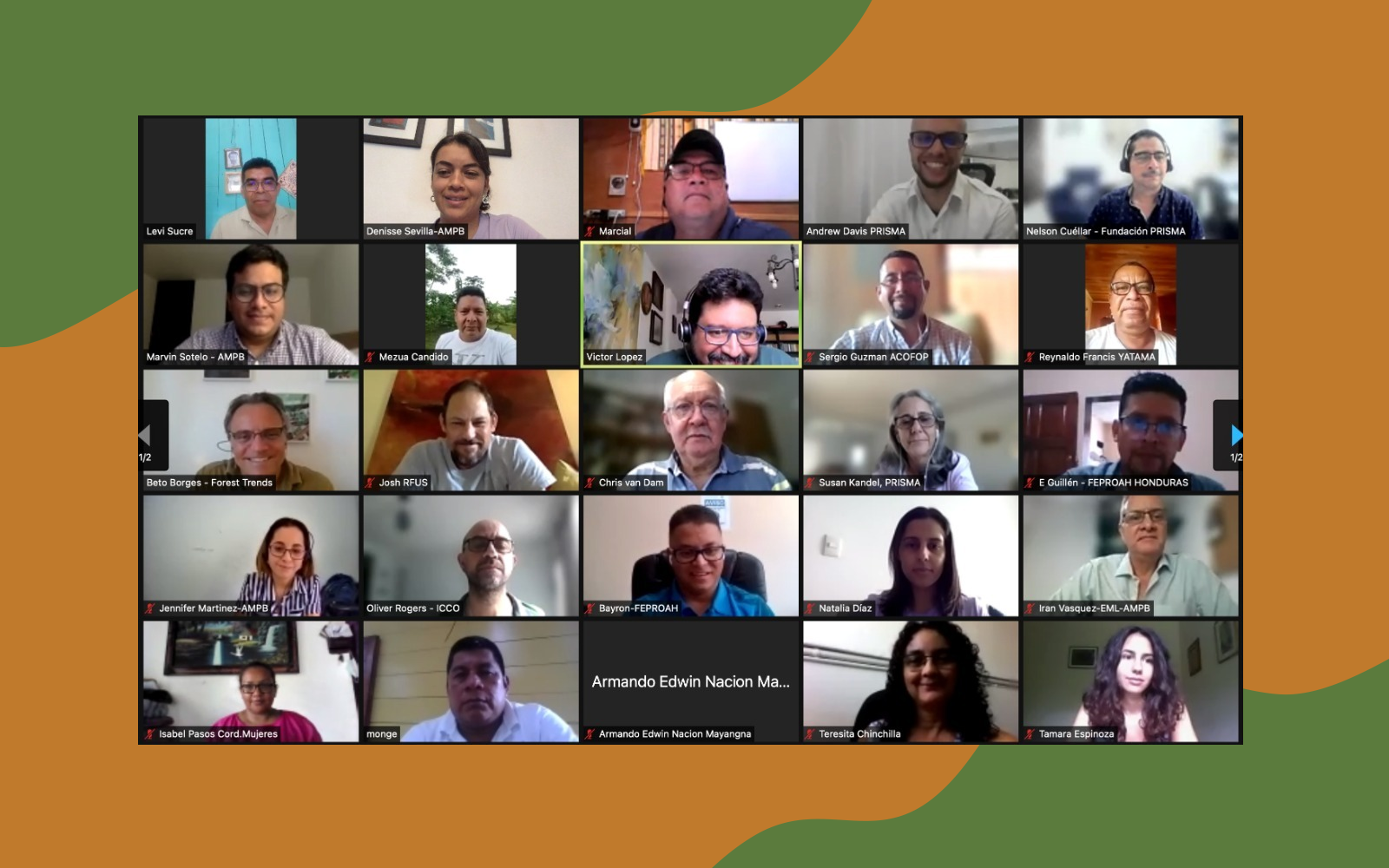
Este martes 7 de setiembre, la Alianza Mesoamericana de Pueblos y Bosques (AMPB) organizó un taller con sus miembros y aliados con el propósito de brindar los detalles sobre el programa de La Coalición LEAF, realizar una actualización del estado de la región en materia de procesos nacionales y subnacionales de la iniciativa Reducción de las emisiones de la deforestación y la degradación de bosques (REDD+) y la participación de los pueblos indígenas y comunidades locales.
The event discussed the status and monitoring of REDD+ processes in each country, the progress made and the difficulties encountered. The possibility of climate finance in the territories and the evolution of this initiative in Mesoamerica over the last decade were also discussed.
"After 13 years of preparation and more than 500 million dollars invested in REDD+ readiness, the most important part of stopping deforestation is precisely where the investment has been lacking. It is urgent that climate finance mechanisms really land at the local level to strengthen the communities that are on the front line of the drivers of deforestation," said Andrew Davis, a researcher and expert on forests and territorial governance issues.
"Today we had a reunion of the community environmental agenda through the territorial leaders of the members of the Mesoamerican Alliance of Peoples and Forests, we were able to identify a "scenario of lights and shadows" and this because after 10 years of being in the REDD+ discussion in Central America that we proposed from the beginning with respect to rights, In many cases, governments have gone backwards in relation to indigenous peoples and local communities in Mesoamerica," said Levi Sucre Romero, coordinator of the AMBP.
The second part of the workshop focused on the LEAF Coalition program "Reducing Emissions through Accelerated Forest Finance", in which the opportunities, threats and challenges of this program for Mesoamerica were analyzed.
"The enthusiasm and interest in supporting actions against deforestation is very welcome, but it is worrying that LEAF does not have the necessary measures to ensure that the territorial rights of indigenous peoples are respected and to ensure that climate finance strengthens precisely those local community arrangements that are the most decisive in the fight against deforestation," said Davis.
According to Davis, it is urgent that there are financing mechanisms such as the Mesoamerican Territorial Fund that do have these concepts implicit and the need to strengthen facilities, technical and administrative capacities, natural resource management and territorial defense, "if we are really talking about stopping deforestation they have to be directed to efforts of this nature".
“Gracias a este taller, pudimos constatar que aun así tenemos espacio de negociación y propuesta, que el liderazgo territorial, indígena y comunitario de la AMPB es sólido y tiene un planteamientos sólidos sobre la diferencia de sus tierras y sus derechos, estamos listos y preparados para hacer la nueva lucha del programa LEAF que viene aún más a agravar el olvido y la ignorancia deliberada de los gobiernos hacia el respeto de los derechos de los pueblos indígenas y comunidades locales, así como de los recursos naturales que protegemos” manifestó Sucre.
Likewise, this analysis of the environmental issue and global policies in relation to climate change carried out today, provides a basis for all the management that has been carried out as a Mesoamerican alliance within the framework of the Global Territorial Community Alliance.
"We have been demanding rights, participation, respect, non-criminalization of leaders, territorial investment, all the issues that we have been promoting at the global level and today we consolidate it with a diagnosis that shows that the struggle is indeed along these lines and that we continue working on it and that from now on we have to rethink new strategies for dialogue, management, advocacy with governments, not only to influence the climate funds that are already beginning to appear in the region, but also for this new LEAF proposal that President Biden is promoting, management, advocacy with governments, not only to influence the climate funds that are already beginning to appear in the region, but also for this new LEAF proposal promoted by President Biden, which basically seeks to extract resources without control and without respect for indigenous peoples and local communities", commented the Coordinator of the Alliance.
El taller contó con la participación de organizaciones miembros de la AMPB, por su parte, Gustavo Sánchez y Ossiel Torres de La Red Mexicana de Organizaciones Campesinas Forestales (Red MOCAF), Amalia Hernández y Erik Guillén de la Federación de Productores Agroforestales de Honduras (FEPROAH), Sergio Guzmán de la Asociación de Comunidades Forestales de Petén (ACOFOP), Reynaldo Francis de la Organización Indígena Nicaragüense YAMATA, Eloy Frank y Aricio Celso de Nación MAYAGNA, Balbino González del Congreso General Guna, Levi Sucre de la Red Indígena Bribri Cabécar (RIBCA), Edilberto Dogirama del Congreso General Emberá Wounan, Hori Orlando Salanic de la Alianza Nacional de Organizaciones Forestales Comunitarias de Guatemala, Norvin Goff de MASTA – Honduras, además de todo el equipo técnico de la AMPB.
Representatives from the Wildlife Conservation Society (WCS), re:wild, Forest Trends, Ford Foundation, ICCO Cooperation, Rainforest Foundation US and PRISMA Foundation were present on behalf of the strategic allies.
Context of the LEAF Coalition program "Reducing Emissions through Accelerated Forest Finance".
On Earth Day, April 22, a new LEAF Coalition initiative to mobilize at least $1 billion to reward tropical countries for halting deforestation was announced at the U.S.-hosted Climate Leaders Summit. The initiative will offer significant economic incentives to protect tropical forests by selling carbon credits to prevent deforestation. Part of the goal is to prevent developing nations from having to choose between ecological integrity and economic progress.
Launched by Norway, the UK and the US, LEAF is a public-private partnership that also involves companies such as Amazon, Airbnb, Bayer, Boston Consulting Group, GlaxoSmithKline (GSK), McKinsey, Nestlé, Salesforce, Unilever and Emergent in the US. Coalition participants will support high-quality emissions reductions from tropical and subtropical forest countries, enabling efforts to reduce and end deforestation.
For its creators and sponsors, several features of the LEAF carbon credit model make its creation a watershed moment for climate and forests, as according to its proponents it fulfills the original ambitions of the REDD+ concept.