Dawn hasn’t fully lifted over San Andrés, in Guatemala’s Petén department, when Erico Fernando Chi Lainez is already moving through the day’s checklist — calls to make, food to pack, gear to test. As president and legal representative of the Asociación Forestal Integral San Andrés (AFISAP) and a community leader from the Nueva Juventud neighborhood, he has spent much of his life protecting the forest his community depends on. Some mornings begin behind a desk. But today, the forest is calling him back into the field.
fdgsdfg
Erico followed regular protocols preparing for this multi-day visit to the forest concession held by his organization. “I meet with the board, then with the management team, and then the forest overseer to agree on what we’re going to do,” he says. Then, almost as an insistence, he adds what matters most to him: “I coordinate administrative issues, but I like the fieldwork.”
From the town center, the journey to the heart of the concession is not a quick drive — it can take around three and a half hours in the dry season, and up to seven when winter rains turn roads into slow, muddy corridors. Once they arrive, the teams settle into forest camps that will be home for days. From there, they patrol for fire risks, search for signs of illegal logging or hunting, and check camera traps that quietly record the wildlife moving through the trees — the everyday work of keeping a living forest standing.
WhatsApp Image 2026-03-06 at 17.01.09 (2).jpeg
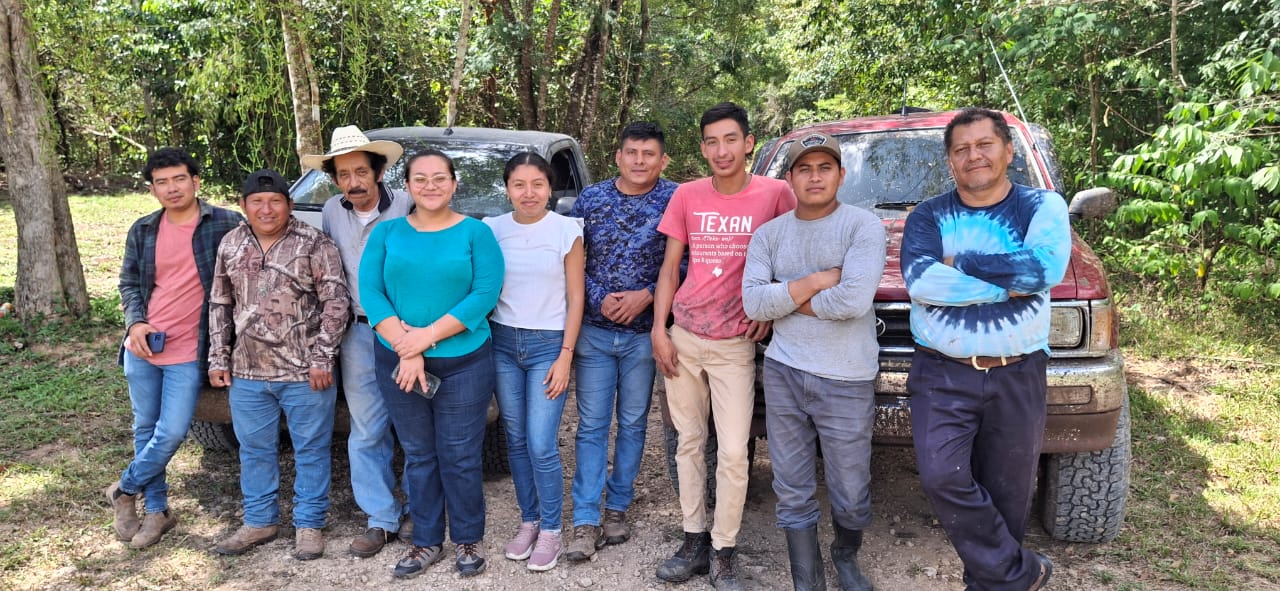
Pie de foto The AFISAP team prepares for their fieldwork deep in the San Andrés region of Petén, Guatemala (Erico Fernando Chi Lainez is to the far right). The trip can take around three and a half hours in the dry season, and up to seven in the rainy season.
Payment for results
The San Andrés concession is one of 13 that comprise the REDD+ Guatecarbon project, a forest carbon initiative developed by community concessions in Petén that since 2012 seeks to reduce deforestation through community forest management and forest conservation. In December 2025, Guatemala received its first results-based payment under its national Program for Emissions Reductions (PRE), supported by the World Bank’s Forest Carbon Partnership Facility. The payment — linked to verified reductions of 4.84 million tons of carbon emissions for the year 2020 — marked the first time the country was paid for protecting its forests at a national scale.
WhatsApp Image 2026-03-05 at 22.03.12.jpeg
Pie de foto: Jaguars are endemic to the Maya Biosphere Reserve and the area of the Guatecarbon REDD+ Project.
Forest protection is one of the most effective and affordable climate solutions. When countries are paid for reducing emissions from deforestation, it creates a financial incentive to keep forests standing. Indigenous Peoples and local communities occupy significant swaths of tropical forests, and are proven to be some of the most effective forest guardians. However, international funding that reaches indigenous peoples and local communities directly remains very limited, estimated at between 1% and 3% of global climate and environmental finance. In light of this, renewed emphasis has been placed on ensuring equitable benefit sharing agreements in carbon market deals.
For the forest communities of the Petén, the news marked not only the long-awaited, first disbursement under the national system, despite having protected forests, reduced deforestation, and generated verified carbon credits for nearly two decades. It also represented a turning point after a long and often uncertain journey. The funding, which reflects the communities’ decades-long effort to conserve the forest, Erico noted, is finally beginning to be valued.
Securing carbon rights without land rights
In Guatemala, Indigenous Peoples and local communities do not all have their land rights recognized. In the Petén, their access to forests are granted as holders of ‘forest concessions’ on lands which are ultimately state owned. When Guatemala passed its Climate Change Law in 2013, it did not clearly recognize community forest concessionaires as owners of carbon rights, and therefore rights to the emissions reductions generated on those lands.
Erico recalls how the process began with a struggle for the right to manage a larger territory. “As an urban center, we didn’t have rights to a larger swath of forest. We started meeting and looking for ways to acquire land, because where else would our people make a living?” he explains.
WhatsApp Image 2026-05-01 at 16.01.18.jpeg
Pie de foto: Members of AFISAP mark the boundaries of their forest concession to notify intruders who may be unaware of their forest management mandate.
For years, they faced doubts from the authorities about their capacity to live by protecting the forest. “They didn’t believe in us… they said how could we protect the area if we didn’t have resources, and besides, unlike other communities, we didn’t live within the protected area,” he remembers. However, after persisting and organizing, the community succeeded in obtaining a forestry concession. They made their income from sustainably harvesting forest products, which was possible because of their effective forest stewardship and action to prevent fires, and illegal logging and poaching on the lands.
Once carbon markets emerged as another income stream, the forest concessionaires once again had to prove to the government that their forest protection and stewardship contributed to emissions reductions and therefore the right to access a fair share of any earnings linked to carbon.
Through ACOFOP (the Association of Forest Communities of Petén), the concessionaires organized collectively to advocate to secure their rights. A new case study jointly published by ACOFOP and Rainforest Foundation US documents their efforts, from proactively engaging in the design of the national Program for Emissions Reductions, to conducting technical and legal analyses and policy proposals, lobbying legislators and engaging with government agencies to shape the national benefit-sharing agreement.
Their efforts led to a key breakthrough: Decree 20-2020, which recognized the role of “implementers” — including community concessionaires — as eligible beneficiaries of emissions reductions payments.
Sergio Guzmán, the lead technical advisor for ACOFOP on climate change, played an important role in those efforts since joining the organization in 2012. “We did not win recognition through wishful thinking,” he said. “We organized ourselves, we built solid forest enterprises, and we proved with data that we were reducing deforestation. When we sat at the negotiation table, we did not speak as victims — we spoke as partners who had already delivered results. That is how ACOFOP secured legal recognition for our emissions reduction rights.”
This political win – underscored by the recent payment for results – is especially significant during a time when carbon markets are often controversial. Around the world, Indigenous Peoples and local communities have faced new violations of their rights as carbon markets expand. REDD+ projects and programs are frequently marked by non-existent and poor consultation, lack of access to unbiased legal and technical advice, unrecognized land rights and in consequence unclear carbon rights, and imbalances of power in negotiations and as a result unequal benefit sharing. In some cases, communities have been excluded from – or never consulted on – decisions, even when projects are located on or near their lands.
Guatecarbon stands out because it shows a different path that emerged from the territory and from vision. It is a case where Indigenous and community forest managers designed and implemented a project from the ground up through internal organizing and building strong governance systems. It is a case in which they successfully influenced national law and secured formal recognition as ‘implementers’ of carbon reduction activities. Guatecarbon proves the value of Indigenous and community-led climate action, not only at the local level in protecting forests from deforestation, but in a way that advances national and global climate goals. Therefore, for many Indigenous Peoples’ and local community organizations in the region, the Guatecarbon case has become a reference point for how communities can participate in carbon markets under fairer conditions.
Turning the tide in Mesoamerica
Not all Indigenous Peoples and local communities in Mesoamerica are in the same political or technical position as those in Petén. Some face weaker legal protections, fewer technical resources, or more centralized government systems.
Rainforest Foundation US’s partner, the Mesoamerican Alliance of Peoples and Forests (Alianza Mesoamericana de Pueblos y Bosques, or AMPB), and its members are closely tracking the expansion of carbon markets in their respective national contexts and have organized to close capacity gaps at the local level, support members in addressing the specific challenges they are facing, and equipping them to engage on equal footing in negotiations to ensure the design and benefit sharing agreements of programs and projects are equitable and fair.
The publication of The Comprehensive Guide on Rights and Transparency in Carbon Markets and REDD+ Projects (Guía Integral Sobre Derechos y Transparencia en Mercados de Carbono y Proyectos REDD+), a central tool developed by AMPB, captures the best practices and lessons learned for effective engagement in carbon markets written by and for Indigenous Peoples and local communities in Mesoamerica. AMPB has facilitated workshops using this guide with partners in Panama and Honduras (and in short order in Costa Rica and Guatemala as well). The organization now aims to formalize a dedicated certificate program to strengthen technical teams embedded with key capacities at the territorial level to be able to more effectively respond to the proliferation of projects and programs within the local context.
poner una al lado del otro
https://drive.google.com/file/d/12eFcfBDSDWDEcT55Mq82GA9Ainoy7auv/view?usp=drive_link pie de foto: Fernando Chi Lainez, president of the Asociación Forestal Integral San Andrés Petén (AFISAP), presenting at a meeting of the Association of Forest Communities of Petén (ACOFOP), the organization where concessionaires organize collectively to advocate for their rights.
https://drive.google.com/file/d/1hr0aGuYXHUeElAEEvliNqu33QP-W0J1g/view?usp=drive_link pie de foto: The new funds received from Guatecarbon facilitated the construction of new administrative offices where AFISAP staff can meet.
Sergio has been one of these trainers, having co-led the workshops with AMPB’s Secretariat in Panama and Honduras to date. AMPB has had the benefit of leveraging his knowledge and experience – and, by extension, that of ACOFOP – to strengthen the response peer organizations can have in addressing the onslaught of market players in their regions.
“Violations of Indigenous Peoples’ rights in one REDD+ project doesn’t always just affect them – if they keep happening, they can become a troubling trend that can have far ranging impacts in the sector,” warns Sergio. “The same logic goes for effective solutions. The sooner we can share what works, what effective solutions look like, paired with adequate training and tools, the quicker those learnings can be replicated and applied to turn the tide towards equitability.”
A promise for equity and integrity in carbon markets
The experience of Guatecarbon offers a broader lesson for the future of carbon markets in the region. Even in complex political contexts, communities can begin by strengthening their own institutions, documenting their forest stewardship, and building technical capacity to participate in these mechanisms. Over time, this generates influence. Guatecarbon does not suggest that carbon markets are simple or risk-free. But it does show that when communities are organized, technically prepared, and persevere, they can influence national systems and help ensure that climate finance reaches the people who protect the forest best.
WhatsApp Image 2026-03-06 at 17.01.09 (1).jpeg pie de foto: The AFISAP team prepares to install a new camera trap in their community forest concessions in order to monitor biodiversity in the area.
For community leaders like Erico, this process also involves shared responsibilities. From the communities’ perspective, the commitment is to manage resources transparently and strengthen the organizations that have protected the forest for decades. «It is up to us to make good use of the resources we have received from Guatecarbon,» he says. In his case, AFISAP was able to purchase the new truck he was about to load his team and equipment into for their upcoming fieldwork, which was purchased to strengthen monitoring efforts in the territory, allowing them to reach areas farther from the concession. The funds also allowed them to fortify the monitoring tools they were about to deploy, such as camera traps, which are used to record biodiversity and detect threats like hunting and logging.
But he also emphasizes that the success of these mechanisms depends on a broader effort: the support of allies who have backed forest conservation, and highlights the role of leaders and representatives of the Indigenous Peoples and local communities. “Political will is needed to make the processes more agile and less bureaucratic.”
Erico hopes to pass his affinity for the forest on to his children, the way his parents once passed it on to him. He still remembers being a boy, walking into the woods alongside his mother and father during the chicle harvest. “We lived off the resources of the forest,” he says. Back then, they carried almost nothing — just cooking oil, salt, and sugar — because the rest could be found or grown along the way: fish pulled from the streams, and corn, bananas, and sweet potatoes his family cultivated. Those early trips didn’t just teach him how to survive in the forest. They taught him what the forest means — and why protecting it is inseparable from protecting the future of the communities that depend on it.
Now he goes out with his own children — all four of them — following familiar trails into the concession. On his family’s lands they have set up a simple camp, where they also raise chickens and pigs. When they pack for the journey, the list is nearly the same as it was in his childhood: cooking oil, salt, sugar. And one new thing, he adds with a small note of satisfaction — coffee.